VR Voyage: to the Amsterdam of the 17th century
You put on a VR headset. The boat glides calmly through the canal. And suddenly, you find yourself in the middle of Amsterdam 400 years ago: a bustling market on the Herengracht, hundreds of ships in the harbor, people working, calling out, and living as they did during the Dutch Golden Age.
VR on a boat may sound like an unexpected combination. Yet thousands of visitors have already experienced it. Their reactions are unanimous: ‘magical’, ‘unique’, and ‘unforgettable’. In this blog, we explain how VR Voyage — the world’s first VR boat tour — came to life.
Authenticity has been central from the very beginning. Extensive historical research was conducted based on:
-
14 historical books
-
Dozens of documentaries
-
Conversations with (maritime) historians
-
Hundreds of online sources and archives
In addition, the entire Amsterdam City Archives were consulted, specifically focusing on the 17th century and the exact locations along the route. This research provided insights not only into historical events but also into daily life and the way streets looked back then.
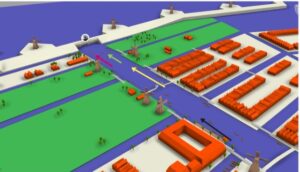
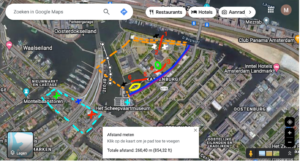
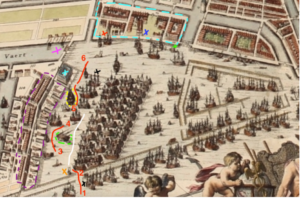
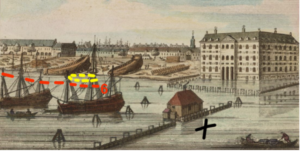
Furthermore, dozens of historical city maps were used, some of which were only available on request. These maps were carefully compared with the current layout of Amsterdam via Google Maps and Google Street View, ensuring that virtual and real locations align perfectly.
From idea to technology
The concept was ambitious, but the technical execution was at least equally challenging. VR Voyage is the world’s first boat tour to implement VR. This meant that almost everything had to be developed from scratch: software, animations and hardware.
Smart software on water
To ensure all VR headsets work perfectly in sync custom software was developed. The VR headsets not only make the visual experience possible but they also serve as an audio guide. In between VR moments, visitors listen to stories and information through the same headset. Therefore, among many other functions the software needed to:
-
Be GPS-driven to make sure content starts at the right location
-
Support multiple languages
-
Allow for different viewing directions
-
Operate reliably on a moving boat
This even required modifications of the operating system of the VR headsets. After months of testing and optimization, the software was ready for use.
Historical Amsterdam, carefully reconstructed
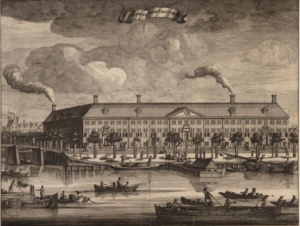
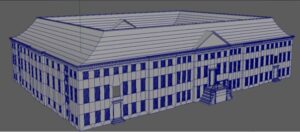
For the tour, complete sections of Amsterdam were recreated in 3D at seven locations, historically accurate and precise within 0.5 meters. Buildings, quays, bridges, and objects were carefully modeled and animated.
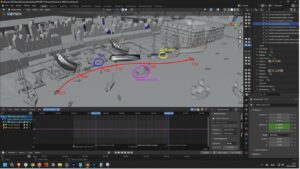
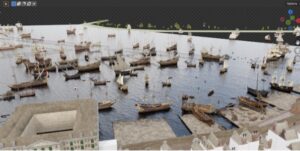
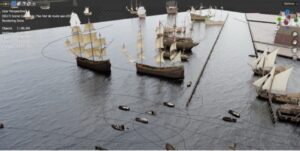
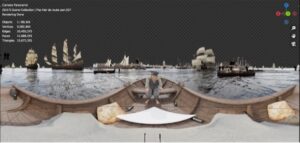
Maritime traffic also played a major role in Amsterdam’s history and thus, in the animation. Large historical ships were added, including a historically accurate 3D model of the Batavia, at that time the largest ship ever built. This vessel was constructed in Amsterdam at the Peperwerf — a location that visitors pass both virtually and in real life.
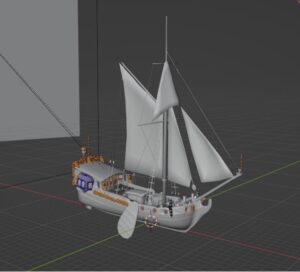
Two historically accurate 3D models of the Fluytschip and the Pinas were used, both of which were only very recently developed by the Netherlands Cultural Heritage Agency. Smaller boats were partly sourced externally and partly developed specifically for VR Voyage.
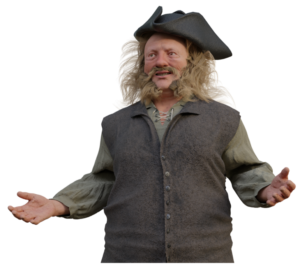
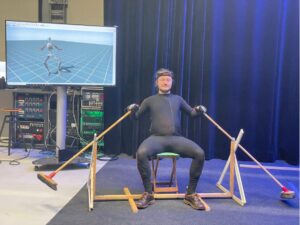
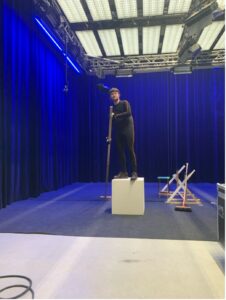
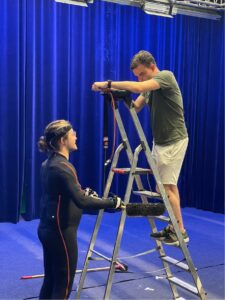
Characters brought to life
Sound, voices and storyline
Sound is essential for the experience. Many ambient sounds could be sourced externally but voices and dialogues were recorded specifically for the tour. While AI is improving in this area, it is still not suitable for natural, multilingual conversations with emotion and timing.
That’s why voice actors were hired for the voice-over, for Pete and for several other characters. The result is an immersive story that is both historically accurate and accessible.
The result: history you can experience
Visitor’s reactions speak for themselves. On platforms like Tripadvisor and Google, VR Voyage is described as “unique”, “surprising”, “the best boat tour ever” and “the highlight of the stay in Amsterdam.” What makes this experience special is that visitors can directly compare modern Amsterdam with how it looked 400 years ago. You’re not just looking at history — you’re standing in it. You become part of the story.
VR Voyage brings technology, imagination, and historical storytelling together in one experience. With spectacular visuals, a strong narrative and a touch of Amsterdam humor, the tour takes you to a city you thought you knew but now truly experience. Curious? Step on board and discover for yourself how 17th-century Amsterdam comes to life!