De oprichting van XR Visuals Factory en het begin van VR Voyage
Have you ever wondered what neighborhoods and streets in Amsterdam must have looked like hundreds of years ago?
We have. This is the story of the founding of XR Visuals Factory and the beginning of VR Voyage. Sometimes a company does not begin with a polished business plan, but with a sense of wonder. With a simple question: what if you could not only look at the past, but truly experience it?
The founding of XR Visuals Factory
While sailing through the canals of Amsterdam — something I, Michiel Coebergh, often did — I regularly asked myself the question: what might these streets and canals have looked like in the past? With little knowledge of their history, but aware that the buildings along the canals were already hundreds of years old, the thought kept returning as I sailed through the city. That curiosity became the starting point.
The first concrete idea arose while watching the large canal cruise boats operating in the center of Amsterdam. (Audio) guides tell beautiful stories about history and everyday life. But what if you could not only hear those stories, but see them come to life around you?
I wondered whether visitors on the large canal cruise boats in Amsterdam would not find it amazing if they could see what their immediate surroundings looked like in the past during the boat trip. At first, I thought of screens on-board showing these visuals. But a logical next step soon followed: if you can show this on a screen, why not surround someone completely with it — using a VR headset? And if so, this concept could be applied in many places at home and abroad.
From this, the concept of VR Voyage was born: a cruise in which visitors put on a VR headset at specific locations to experience their surroundings as they were in the past. In theory, that step felt small. In practice, it turned out to be a giant leap.
The first explorations
In January 2021, I began to investigate whether this idea was even feasible. A series of Google searches gave me confidence on the one hand and doubt on the other. The idea of VR on a boat appeared to exist nowhere. That was encouraging — but also raised an important question: why not?
The first party I thought should know something about this stopped answering the phone after a few attempts. That did not bode well. Fortunately, a second party offered significantly more perspective. In the meantime, I was reading up on the history of Amsterdam, had devised a sailing route with a script for the animations, and had approached various potential partners such as museums.
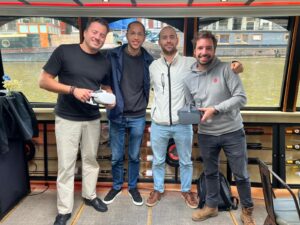
It was time to think about which shipping company to approach. I also considered the idea of operating boats under my own management. During that period, I got into conversation with Joost Voortman, whom I knew from the Amsterdam boating world. Joost had just started his own shipping company, and when I explained what I was working on, he almost immediately indicated that he wanted to be involved — and so it came to pass.
After several meetings and the first tests on the water, a cautious feeling began to emerge that this concept might actually succeed. This was the moment when the development of the product truly began.
The beginning of VR Voyage
Although it became clear that VR on the water was technically possible, extensive testing also brought new challenges. Software had to be developed to control the VR headsets. Different viewing directions, languages, synchronization with the environment, limited battery life of the VR headsets — all of these were factors that needed to be resolved. Each solution brought new complications, but the most important thing was: the beginning was there.
Slowly, the concept grew into what VR Voyage is today: a cruise in which visitors put on a VR headset at specific locations and see their surroundings as they looked in the 17th century. They are in exactly the same place as back then, but looking hundreds of years into the past (more information). As the boat calmly continues its journey, their surroundings transform into a lively 17th-century scene. Environments and buildings appear as they once did, ships pass by, and the city comes to life as it did centuries ago.
The challenge of historical VR
Developing VR Voyage was about more than just technology. It meant working with historical source material, reconstructing architecture, and finding the right balance between historical accuracy and immersive experience. Everything had to be right: scale, perspective, historical buildings, light, movement. Only when everything is right do you forget, for a moment, that you are wearing a VR headset.
And it is precisely that moment — when visitors fall silent, look around, and smile — that repeatedly confirms why XR Visuals Factory exists.
The mission of XR Visuals Factory
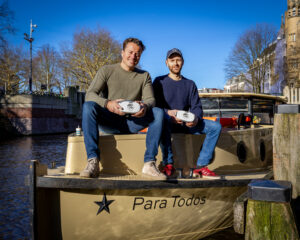
XR Visuals Factory is a company built on curiosity, imagination, and the belief that stories become stronger when you can experience them. And we have one clear mission: to make historical stories tangible on location using XR technology.
VR Voyage is the first product, but above all it is proof of what is possible when technology and storytelling come together. The Amsterdam canals were the starting point, and VR Voyage the beginning. The ambition reaches further.
This is just the beginning.